
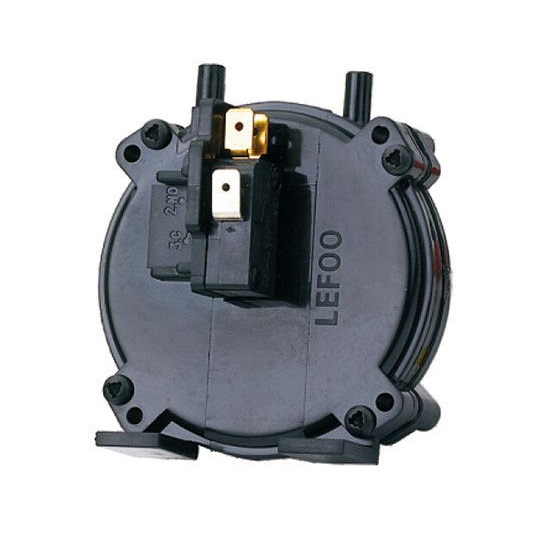
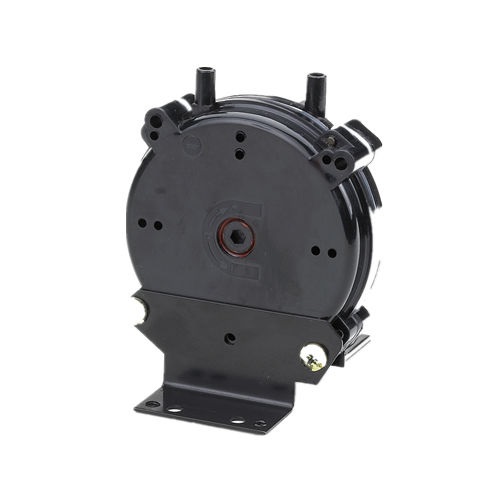
LF30
LF30 Pressure Switch
| Medium | Air, products of combustion, L.P., or natural gas | |
| Mounting /Fixing | 4 screws with a maximum penetration depth of 6.3mm into appropriate mounting holes, or fixed with an optional bracket | |
| Mounting Position | The LF30 is position sensitive. It may be mounted in most positions provided it has been calibrated | |
| Field Adjustable Range | 0.4mbar to 8.0mbar make positive or negative pressure rise. Minimum upper switching pressure 0.4mbar. Minimum lower switching pressure 0.2mbar | |
| Switch Differential | Not less than 0.1mb and not greater than 0.3mb depending on pressure settings | |
| Maximum Operating Pressure | 10mbar Pmax = 50mbar | |
| Operating Temperature Range | 105OC Maximum | |
| Electric Rating | 125V, 250V, 5A single pole on-off or single pole change over. Other ratings are available on request | |
| Contact Arrangement | SPDT or SPST | |
| Terminals | 6.3 or 4.8 mm male Q.C. Optional insulation cover available as necessary | |
| Calibration | LF30 switches are normally calibrated at their lower switching pressure in accordance with customer requirements. | |
| Ramp rate at switch point = 0.03mb / second | ||
| Calibration Tolerance | Standard production tolerance at ambient temperature is ± 0.10mb or ± 5% of setpoint, whichever is the greater | |
| Pressure Connections | 6mm O.D. push-on or “Permifix” tubing. The lower (negative) connector may be supplied in any one of four positions for ease of installation | |
The LFAS employs a differential pressure to actuate a precision snap switch at chosen pressure setting. This may be the difference between atmospheric and a negative or positive pressure or between any two given pressures. When a change of pressure occurs between the negative pressure chamber and the positive pressure chamber the main diaphragm activates the snap switch at a pre-determined value.
The LF30 pressure cut-off switch is manufactured from selected compound derivatives of polycarbonate & PBT offering exceptional thermal and dimensional stability at elevated temperatures up to 105°C when used in contaminated atmospheres of air, products of combustion, L.P., or natural gas.
It has been designed to meet the low-pressure, high-temperature, specifications of future generations of fanned gas and similar appliances where differential pressures form part of an integrated control system.
Typical Applications:
Detects airflow in forced draught appliances
Signals either positive, negative, or zero air movement
Shut down burner in blocked flue conditions
Guards against poor or hazardous combustion
Indicates dirty or inefficient filters